SlotLounge registration and KYC for Australian players
 Available in AU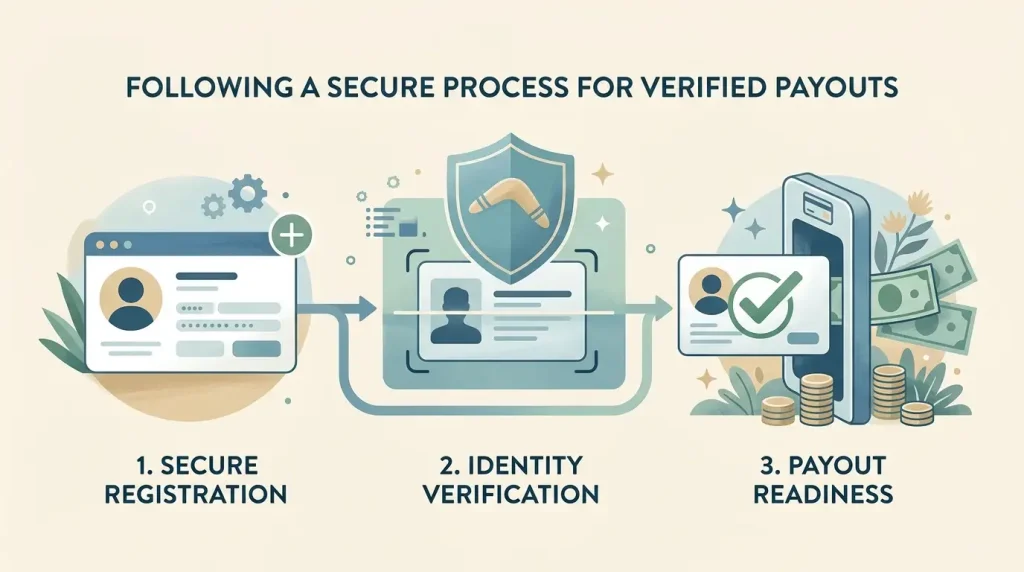
Opening a SlotLounge account involves providing normal account details and confirming that you meet the age and jurisdiction requirements in the operator’s terms. SlotLounge accepts adults only, with 18 as its stated minimum age, and it reserves the right to request proof of age. Identity verification is also part of the account lifecycle: the current terms allow the casino to check identity before processing payouts and to hold a withdrawal while verification is completed. The current Privacy Policy says account information can include name, date of birth, contact details and government-issued ID for verification.
The key practical point is that registration and KYC are connected. A user can create an account before a payout request, but later withdrawal activity can trigger identity checks. The verification sequence and review time can vary by account, so check the current request shown in your account.
Table of Contents
- What the sign-up process is trying to establish
- Age and jurisdiction checks
- What KYC means at SlotLounge
- Why verification matters most at withdrawal
- How long can KYC take?
- One account, bonuses and identity consistency
- What information should be kept consistent?
- Privacy and verification data
- Support if verification is unclear
- A practical registration and KYC checklist
- Registration, KYC and the bigger SlotLounge picture
What the sign-up process is trying to establish
Registration creates the player account that connects identity details, contact information, payment history, bonuses and game activity. SlotLounge’s terms state that registering an account means agreeing to the site’s terms, while its Privacy Policy describes collection of account details such as name, date of birth, email, phone number and verification information.
For an Australian user, the most important starting point is accuracy. Account details should reflect the person who will actually use the account and the payment methods attached to it. That becomes important later if the operator asks for age or identity verification. A mismatch between registration data, payment information and identification can create a preventable verification problem.
SlotLounge provides an English-AU route, so Australian users can access a localised English version of the site. Localisation, however, is not the same thing as Australian licensing. Questions about the operator’s licence and the Australian regulatory environment belong on our SlotLounge licensing page rather than being inferred from the sign-up screen.
Age and jurisdiction checks
The current terms say SlotLounge accepts strictly adult players, with a minimum age of 18, as well as any higher age required by the law where the player resides. The operator also reserves the right to ask for proof of age and to limit access or suspend an account if that requirement is not met.
The same terms say players are accepted only from countries and geographic regions where online gambling is allowed by law and place responsibility on the player to understand local rules. Australia is not named in the general restricted-country list in the current terms, but that fact should not be turned into a blanket legal conclusion. Australian interactive-gambling regulation is its own topic and is covered separately in the site’s Australia and licensing material.
From an account-management perspective, the useful takeaway is straightforward: do not treat successful account creation as proof of regulatory status. Registration is an operational step. Jurisdiction and licensing are separate questions.
What KYC means at SlotLounge
KYC, or “know your customer”, is the identity-verification process used to establish that an account belongs to the person operating it. SlotLounge’s current Terms and Privacy Policy explicitly describe identity verification. The Privacy Policy says account information may include a government-issued ID for verification, while the Terms say casino management can require identity-related documents and can request additional verification in specified circumstances.
The current Terms also mention examples such as ID, payment-system evidence and utility bills, and they provide for video verification when required documents cannot be supplied in the stated alphabets. These are current official examples, not a promise that every Australian user will be asked for every item. The exact request can depend on the account and the verification issue being resolved.
This is why copying a generic casino KYC checklist into a review is misleading. The useful source is the actual request shown to the account holder, together with the operator’s current terms. A player should submit only the documents requested through the legitimate SlotLounge verification process and should avoid sending sensitive identity material to addresses or sites that cannot be confirmed as official.
Why verification matters most at withdrawal
The clearest operational link between KYC and withdrawals appears in the withdrawal policy. SlotLounge reserves the right to check identity before processing payouts and to hold a withdrawal for the time needed to perform that check. The broader terms also say withdrawals may be stopped until the account is fully verified.
This means the account can feel frictionless during registration and deposits but become more demanding when funds are being paid out. That is not a contradiction: verification can be triggered later in the account lifecycle. For planning purposes, users should therefore treat KYC readiness as part of withdrawal readiness rather than something that matters only at sign-up.
The same principle applies to the payment method. If the account holder cannot demonstrate the relationship between their identity and the payment route, verification can become harder. Our AUD payment methods guide explains the supported payment categories, while the withdrawal page handles current cash-out limits and processing details.
How long can KYC take?
There is no single universal KYC completion time that should be promised to every user. The current SlotLounge terms do contain timing language connected with withdrawals and identity checks, but the practical duration of a verification case depends on what is requested, whether the submitted information is complete, and whether further review is needed.
Verification times can vary, so check the current account status and any document request shown by the casino. A better approach is to check the account status, respond to the current document request and contact support if the verification state is unclear. This avoids turning one operational clause into a service-level guarantee for every account.
One account, bonuses and identity consistency
Account identity also matters for promotions. SlotLounge’s bonus terms say bonuses are limited to one per person or account and extend that restriction across identifiers such as household, address, email, card number and shared-computer environments. That creates a practical reason to avoid duplicate accounts: promotional eligibility and fraud controls can overlap with account verification.
A user considering a welcome offer should therefore read the SlotLounge bonuses page before activating a promotion. The relevant point here is not the size of the offer but the way account identity, one-account rules and later KYC can interact. If registration data is inconsistent or multiple accounts are created, the resulting issue can affect more than login access.
What information should be kept consistent?
- Name and date of birth
- These are core identity fields described in the Privacy Policy and should match the user’s real identity information.
- Email and phone details
- Current contact details matter because account or verification communication can be sent through those channels.
- Payment ownership
- Using a payment route connected to the account holder makes later verification easier to explain and document.
- Residential information
- Where address information is requested, it should be current and consistent with any proof later requested by the operator.
The objective is not to over-submit information. It is to avoid contradictions between the account profile and the evidence the operator may later request.
Privacy and verification data
KYC also changes the sensitivity of the information attached to the account. SlotLounge’s Privacy Policy says it processes account details, financial information, gaming activity and technical information such as device and geolocation data. For a user, that makes the verification channel itself important. Identity files should be uploaded only through the official verification process or another channel clearly confirmed by SlotLounge support, not through links received from unknown third parties.
It is also sensible to distinguish between information needed to run the account and information needed to prove identity in a particular case. The operator may already hold registration and transaction data before it asks for additional verification. A request for further evidence is therefore not the same as opening a new account: it is a check against the existing profile, payment history or payout request. Keeping the original account details correct reduces the chance that later evidence conflicts with what was supplied at sign-up.
Users should also avoid sharing more identity information than the verified request requires. The goal is to satisfy the current account check, not to create unnecessary copies of sensitive documents across email threads, messaging apps or unofficial support channels.
Support if verification is unclear
SlotLounge advertises support as available 24/7, and email is also listed as an available support channel. If a verification request is unclear, the most useful questions are specific: what item is still outstanding, whether the submitted file was accepted, whether another format is required, and whether the withdrawal is waiting on verification or on payment processing.
Keeping the question narrow helps separate KYC from payment timing. A withdrawal can be delayed because identity review is incomplete, because the payment rail itself takes time, or because further account checks are required. Those are different states and should not be collapsed into a generic “withdrawal problem”.
For users primarily accessing the account from a phone, the SlotLounge mobile guide explains the available mobile routes. The same security principle applies: use the official site or app route and avoid uploading identity documents through unverified third-party links.
A practical registration and KYC checklist
- Use accurate personal details from the start.
- Confirm you meet the age requirement and understand the rules that apply where you live.
- Avoid opening duplicate accounts, especially to repeat a bonus.
- Use payment methods that you can reasonably connect to your identity.
- Read the actual KYC request rather than relying on a generic document list.
- Submit only requested documents through a verified SlotLounge channel.
- Confirm whether any identity checks are still pending before assuming a withdrawal delay is purely related to payment processing.
- Keep copies of relevant account communications in case support needs to trace the request.
Registration, KYC and the bigger SlotLounge picture
The account lifecycle is only one part of assessing the casino. Our full SlotLounge Australia guide covers the broader brand, while the payments and bonus pages separate funding and promotion questions from identity verification. This separation matters because KYC should not be used as a blanket explanation for every casino feature.
The central point is simple: SlotLounge’s official policies make identity verification an explicit part of operating an account, particularly around payouts. The current terms support age checks, identity checks and a requirement to complete verification where requested. They also provide concrete examples of documents that can be requested, while the exact request remains account-specific. Register with accurate data, treat KYC as a possible precondition to cash-out, and ask support for the exact outstanding requirement rather than guessing.